

Table of Contents
| Sr. No. | Topic |
|---|---|
| 1 | Understanding Buttweld Fittings |
| 2 | Types of Pipe Fittings |
| 3 | Materials and Specifications |
| 4 | Benefits and Advantages |
| 5 | Industrial Applications |
| 6 | Selection Guide |
| 7 | Why Choose Bouka Metals |
| 8 | FAQs |
| 9 | Conclusion |
Understanding Buttweld Fittings
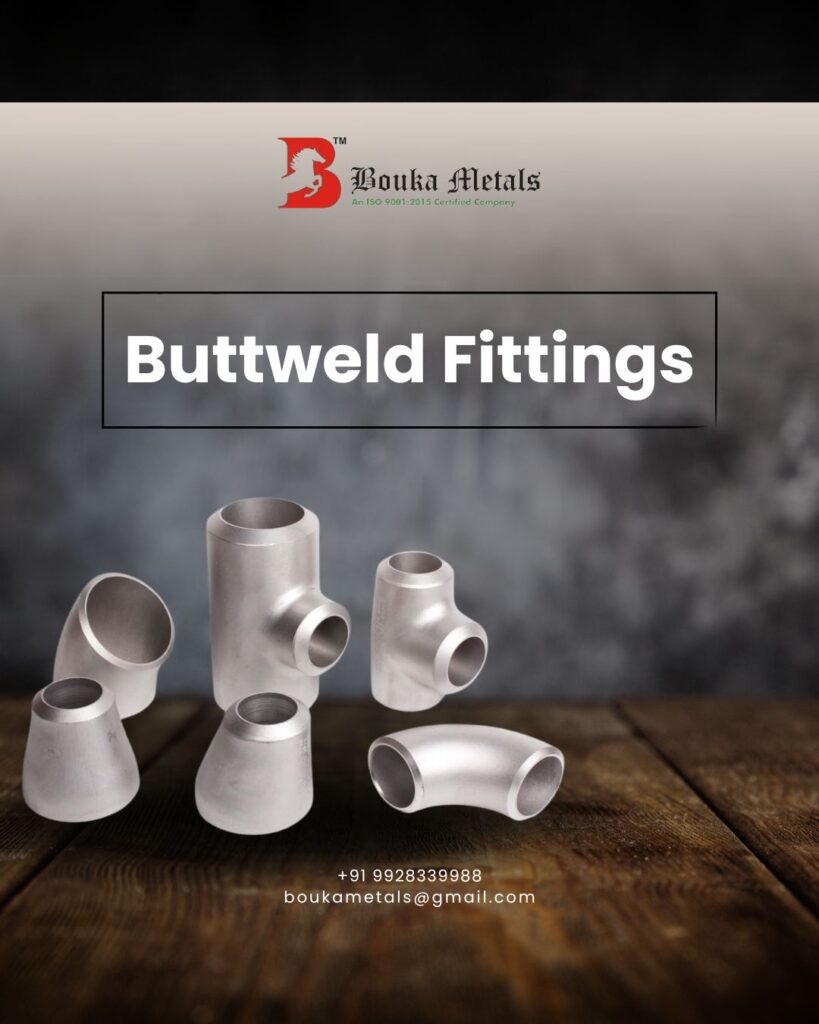
Buttweld Fittings are piping components welded directly to pipes to create a continuous and permanent connection. These products are designed to handle high pressure, elevated temperatures, and demanding industrial environments. The welding process creates a smooth internal surface that improves flow efficiency while reducing turbulence and pressure loss.
The popularity of these piping components continues to grow because industries require dependable systems capable of operating for years without frequent maintenance or replacement. Their strong construction makes them one of the most preferred choices for critical applications.
Types of Pipe Fittings
Different applications require different configurations.
Table 1: Common Types
| Type | Function |
|---|---|
| Elbow | Changes flow direction |
| Tee | Creates branch connections |
| Reducer | Connects different pipe sizes |
| Cap | Closes pipeline ends |
| Stub End | Used with lap joint flanges |
Each fitting serves a unique purpose in maintaining efficient fluid transportation and ensuring system reliability.
Materials and Specifications
Material selection directly affects performance and service life. The operating environment, temperature, pressure, and media being transported all influence the choice of material.
Table 2: Material Comparison
| Material | Key Benefit |
|---|---|
| Stainless Steel | Corrosion resistance |
| Carbon Steel | High strength |
| Alloy Steel | Heat resistance |
| Duplex Steel | Superior durability |
| Nickel Alloy | Chemical resistance |
Most industrial projects follow ASTM, ASME, and MSS standards to ensure quality and safety.
For industry standards and technical references, visit https://www.asme.org
Benefits and Advantages
Industrial facilities prefer welded piping solutions because they offer outstanding mechanical strength and long-term reliability. The welded connection minimizes leakage risk and helps maintain system integrity even under extreme operating conditions.
The smooth internal bore improves flow efficiency, reducing energy consumption and operational costs. These components also require less maintenance compared to threaded alternatives, making them a cost-effective investment for industrial infrastructure.
Industrial Applications
Table 3: Industry-Wise Usage
| Industry | Application |
|---|---|
| Oil & Gas | Pipeline transportation |
| Petrochemical | Chemical processing |
| Power Plants | Steam systems |
| Water Treatment | Fluid distribution |
| Pharmaceutical | Hygienic processing |
| Food Industry | Sanitary piping |
These sectors depend on reliable pipe connections to maintain productivity and safety.
Selection Guide
When selecting piping components, engineers evaluate operating pressure, temperature, corrosion resistance, dimensional compatibility, and industry standards. Choosing certified products helps improve performance and reduces long-term maintenance expenses.
Why Choose Bouka Metals
Bouka Metals supplies high-quality industrial piping products designed to meet international standards. With a strong focus on quality, timely delivery, and customer satisfaction, the company serves diverse industries requiring dependable piping solutions.
Factors Driving the Growing Demand for Industrial Pipe Fittings
The rapid expansion of industrial infrastructure around the world has significantly increased the demand for reliable piping components. Industries are investing heavily in modern manufacturing facilities, energy projects, water treatment plants, and transportation infrastructure. Every one of these sectors requires durable pipeline systems capable of operating efficiently under varying conditions.
As industries focus on improving productivity and reducing operational risks, the need for high-performance piping solutions continues to rise. Advanced manufacturing technologies have further improved the quality and consistency of industrial fittings, making them more dependable than ever before.
Environmental regulations have also influenced the adoption of better piping systems. Facilities handling chemicals, gases, and hazardous fluids must ensure leak-free operations to comply with safety standards and environmental requirements. Buttweld Fittings. This has encouraged engineers to choose welded pipe connections that provide long-term reliability and enhanced operational safety.
In addition, many industries are shifting their focus toward reducing maintenance expenses. Frequent repairs and replacements can result in costly downtime and production losses. High-quality piping components help organizations achieve greater operational efficiency while minimizing maintenance-related disruptions.
Installation Considerations for Long-Term Performance
Proper installation plays a critical role in maximizing the performance and lifespan of industrial piping systems. Even premium-quality products may fail to deliver expected results if installation procedures are not followed correctly.
One of the most important aspects of installation is ensuring proper alignment between the pipe and fitting. Misalignment can create stress points that may lead to premature wear or failure over time. Buttweld Fittings Skilled welders follow precise procedures to ensure accurate positioning and secure weld joints.
Surface preparation is equally important. Before welding, all surfaces should be cleaned thoroughly to remove contaminants such as oil, dirt, moisture, and oxidation. Proper preparation helps achieve stronger welds and reduces the possibility of defects.
Post-weld inspection is another critical step. Visual inspections, dimensional checks, and non-destructive testing methods may be performed to verify weld quality and overall system integrity. Buttweld Fittings. These inspections help identify potential issues before the system becomes operational.
By following industry-approved installation practices, organizations can significantly improve reliability, reduce maintenance requirements, and extend the service life of their piping infrastructure.
The Role of Quality Assurance in Manufacturing
Quality assurance is one of the most important factors that distinguish premium industrial products from low-grade alternatives. Buttweld Fittings Reputable manufacturers implement strict quality control procedures throughout the production process to ensure consistency and compliance with international standards.
Raw materials undergo detailed verification before production begins. Buttweld Fittings Material test certificates are reviewed to confirm chemical composition and mechanical properties. This helps ensure that the final product performs as expected under specific operating conditions.
During manufacturing, dimensional inspections are conducted to verify compliance with required tolerances. Maintaining accurate dimensions is essential for ensuring proper fit-up during installation.
Many manufacturers also perform hydrostatic testing, ultrasonic testing, radiographic examination, and other quality assessments depending on customer requirements and industry standards. Buttweld Fittings. These testing procedures provide additional assurance regarding product reliability and performance.
Investing in quality-tested components helps industries reduce operational risks while increasing confidence in system performance.
Future Trends in Industrial Piping Systems
Technological advancements continue to transform the industrial piping sector. Buttweld Fittings Manufacturers are increasingly adopting automation and precision engineering techniques to improve production efficiency and product quality.
The growing use of advanced alloys is another important trend. Industries operating in highly corrosive environments are seeking materials that offer longer service life and superior resistance to chemical attack. Buttweld Fittings. This has increased demand for duplex stainless steel, super duplex stainless steel, and nickel-based alloys.
Digital monitoring systems are also becoming more common in industrial facilities. These technologies allow operators to monitor pipeline performance in real time, helping identify maintenance requirements before failures occur.
Sustainability is another key focus area. Organizations are investing in durable infrastructure that minimizes waste, reduces resource consumption, and supports long-term environmental goals. High-quality piping solutions contribute to these objectives by providing extended service life and reduced replacement frequency.
As industrial requirements continue to evolve, manufacturers will remain focused on delivering products that meet increasingly demanding performance expectations.
How the Right Supplier Impacts Project Success
Selecting the right supplier is just as important as choosing the right product. A trusted supplier provides more than just materials; they contribute to the overall success of a project through quality assurance, technical expertise, and dependable service.
Reliable suppliers maintain strong inventory levels and efficient logistics networks to ensure timely delivery. Delays in material availability can disrupt project schedules and increase costs, making supplier reliability a critical consideration.
Technical support is another valuable advantage. Experienced suppliers can assist customers in selecting suitable materials, dimensions, and specifications based on project requirements. Their expertise helps prevent costly mistakes and improves overall project efficiency.
Long-term partnerships with dependable suppliers often result in better communication, consistent quality, and improved procurement processes. This allows organizations to focus on operations while maintaining confidence in their supply chain.
Bouka Metals continues to support customers with quality-driven solutions, industry expertise, and a commitment to delivering products that meet the highest standards of performance and reliability.
Frequently Asked Questions
What are Buttweld Fittings?
They are welded pipe components used to connect, redirect, reduce, or terminate pipelines.
Why are they preferred in industrial applications?
They provide strong, permanent, and leak-resistant connections.
Which material is best?
The best material depends on operating conditions. Stainless steel is commonly used due to its corrosion resistance.
Are these suitable for high-pressure systems?
Yes, they are widely used in high-pressure and high-temperature environments.
What industries use these products?
Oil & gas, chemical processing, power generation, pharmaceuticals, food processing, and water treatment industries.
Conclusion
Buttweld Fittings play a critical role in modern industrial piping systems by providing reliable, leak-proof, and durable connections. Their ability to withstand challenging operating conditions makes them an ideal choice for industries where safety and performance are essential. By choosing quality products from trusted suppliers such as Bouka Metals, businesses can enhance system efficiency, reduce maintenance costs, and ensure long-term operational success.
