

Table of Contents
- Introduction
- What Are Brass Strips?
- Key Features of Brass Strips
- Types of Brass Strips
- Technical Specifications of Brass Strips
- Applications of Brass Strips
- Benefits of Using Brass Strips
- Brass Strips vs Other Metal Strips
- Industries That Use Brass Strips
- How to Choose the Right Brass Strip
- Why Choose Bouka Metals for Brass Strips
- Maintenance and Storage Tips
- Frequently Asked Questions (FAQ)
- Conclusion
Introduction
Bouka Metals Brass strips play a significant role in today’s manufacturing and engineering industries. Produced from high-quality brass alloys, these strips are known for their excellent balance of strength, workability, conductivity, and corrosion resistance. Their unique properties allow them to be used in a wide range of applications, from electrical connectors and industrial components to decorative elements and architectural fittings.
One of the major reasons for the popularity of brass strips is their exceptional fabrication capability. They can be easily shaped, punched, welded, and machined without compromising structural integrity. This makes them highly suitable for industries that demand precision and consistency in production.
In addition to their mechanical advantages, brass strips offer an attractive golden appearance, making them valuable for decorative and aesthetic applications. Their resistance to wear and environmental factors further contributes to their long service life. As industries continue to seek materials that combine performance, durability, and versatility, brass strips remain a dependable solution for diverse fabrication and manufacturing needs.
Key Features of Brass Strips
Excellent Formability
Can be easily bent, shaped, stamped, and fabricated into various components.
Corrosion Resistance
Performs well in humid and challenging environments.
High Durability
Provides long-lasting performance under regular operating conditions.
Good Electrical Conductivity
Suitable for electrical and electronic applications.
Attractive Appearance
Natural golden finish enhances decorative applications.
Precision Manufacturing
Available in accurate dimensions and thickness tolerances.
Low Maintenance
Requires minimal upkeep while maintaining performance and appearance.
What Are Brass Strips?
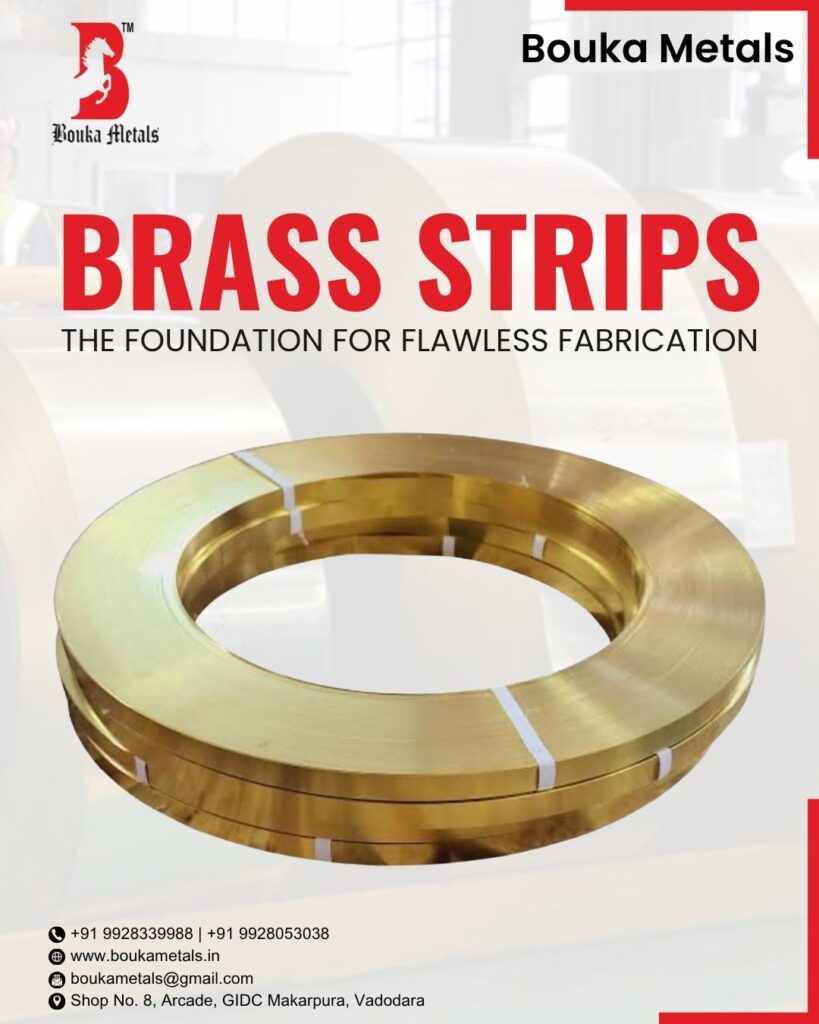
Brass strips are flat-rolled metal products manufactured from brass alloys containing copper and zinc. They are produced in different widths, thicknesses, and tempers to meet specific industrial and commercial requirements.
Due to their mechanical and physical properties, these strips are widely used in fabrication, electrical systems, automotive components, hardware manufacturing, and decorative projects.
Types of Brass Strips
Cartridge Brass Strips
Known for excellent forming and deep-drawing properties.
High Conductivity Brass Strips
Used in electrical and electronic applications.
Commercial Brass Strips
Suitable for general-purpose fabrication and engineering work.
Decorative Brass Strips
Preferred for architectural and aesthetic applications.
Precision Brass Strips
Manufactured for industries requiring tight dimensional tolerances.
Technical Specifications
| Specification | Details |
|---|---|
| Product Type | Brass Strips |
| Material | Copper-Zinc Alloy |
| Form | Strip / Coil |
| Thickness Range | Various Options Available |
| Width Range | Multiple Sizes Available |
| Surface Finish | Bright / Mill Finish |
| Corrosion Resistance | Excellent |
| Applications | Industrial, Electrical, Decorative |
Applications of Brass Strips
Electrical Industry
Used in connectors, terminals, switches, and electrical components.
Automotive Sector
Applied in manufacturing precision automotive parts.
Construction Industry
Used for architectural fittings and decorative elements.
Hardware Manufacturing
Suitable for locks, hinges, fasteners, and accessories.
Engineering Applications
Used in fabricated parts and precision industrial components.
Decorative Products
Preferred for aesthetic and ornamental designs.
Benefits of Using Brass Strips
Easy Fabrication
Supports cutting, bending, stamping, and forming processes.
Long Service Life
Offers durability and reliability across various applications.
Cost-Effective Material
Provides excellent value due to performance and longevity.
Enhanced Appearance
Adds visual appeal to finished products.
Multi-Industry Usage
Suitable for both functional and decorative applications.
Brass Strips vs Other Metal Strips
| Feature | Brass Strips | Steel Strips |
|---|---|---|
| Corrosion Resistance | Excellent | Moderate |
| Appearance | Decorative Finish | Industrial Finish |
| Formability | Excellent | Moderate |
| Conductivity | Good | Lower |
| Maintenance | Low | Moderate |
| Machinability | Easy | Moderate |
Industries That Use Brass Strips
Electrical & Electronics
For conductive components and connectors.
Automotive Manufacturing
For precision parts and assemblies.
Construction Sector
For architectural and decorative applications.
Industrial Fabrication
For custom-engineered components.
Consumer Goods Manufacturing
For hardware and finished products.
How to Choose the Right Brass Strip
Determine Application Requirements
Select the strip based on its intended use.
Check Thickness and Width
Choose dimensions that match project specifications.
Evaluate Mechanical Properties
Consider strength, flexibility, and conductivity requirements.
Verify Material Grade
Ensure the selected brass alloy meets performance expectations.
Consider Environmental Conditions
Choose suitable specifications for exposure conditions.
Why Choose Bouka Metals for Brass Strips
Quality-Focused Products
Supplying reliable brass solutions for diverse industries.
Wide Range of Options
Available in various sizes, grades, and specifications.
Competitive Pricing
Providing cost-effective solutions without compromising quality.
Consistent Availability
Maintaining dependable inventory levels.
Customer Support
Helping customers select suitable brass products for their requirements.
Maintenance and Storage Tips
Store in a Dry Environment
Protect strips from unnecessary moisture exposure.
Avoid Surface Scratches
Handle carefully during transportation and storage.
Keep Away from Contaminants
Maintain cleanliness to preserve surface quality.
Conduct Periodic Inspection
Monitor material condition before fabrication and use.
Frequently Asked Questions (FAQ)
What are brass strips used for?
Brass strips are used in electrical components, fabrication, automotive parts, hardware manufacturing, and decorative applications.
Why are brass strips popular in fabrication?
They offer excellent formability, machinability, and durability.
Are brass strips corrosion-resistant?
Yes, brass provides good resistance to corrosion in many environments.
Can brass strips conduct electricity?
Yes, brass offers good electrical conductivity, making it suitable for electrical applications.
Are brass strips suitable for decorative purposes?
Yes, their natural golden appearance makes them ideal for decorative and architectural projects.
Do brass strips require high maintenance?
No, they generally require minimal maintenance when stored and handled properly.
Are brass strips recyclable?
Yes, brass is recyclable and supports sustainable manufacturing practices.
Conclusion
Brass strips continue to be an essential material for fabrication, engineering, electrical, and decorative applications. Their combination of strength, workability, corrosion resistance, and attractive appearance makes them suitable for a wide variety of industries. Whether used in precision components, electrical systems, architectural designs, or industrial fabrication, brass strips deliver dependable performance and long-term value. Bouka Metals offers quality brass strip solutions designed to meet modern manufacturing and fabrication requirements.
Check this : – https://www.commerce.gov.in/
