

Table of Contents
- Introduction
- What Are Aluminum Sheet & Plates?
- Technical Specifications
- Available Aluminum Grades
- Key Advantages
- Industrial Applications
- Factors to Consider Before Purchasing
- Why Choose Quality Aluminum Products?
- Frequently Asked Questions
- Conclusion
Introduction
Discover aluminum sheet and plates specifications, grades, applications, and benefits. Learn how aluminum products provide durability, corrosion resistance, and versatility for industrial projects.
In today’s industrial landscape, material selection plays a crucial role in ensuring efficiency, durability, and long-term performance. Aluminum has emerged as one of the most preferred engineering materials due to its unique combination of strength, lightweight characteristics, and resistance to environmental conditions. Aluminum sheets and plates are extensively used in manufacturing, construction, transportation, marine engineering, electrical systems, and aerospace applications.
These products are designed to provide excellent structural performance while reducing overall weight. Their adaptability and wide range of available grades make them suitable for both standard and specialized industrial requirements.
Bouk Metals Aluminum Sheet & Plates are widely used across various industries due to their exceptional strength, lightweight properties, and corrosion resistance. These flat-rolled aluminum products offer excellent performance in demanding environments and are suitable for applications ranging from construction and transportation to aerospace and marine engineering.
Available in multiple grades, dimensions, and thicknesses, these products provide flexibility for fabrication, structural support, and industrial manufacturing. Their durability, ease of machining, and long service life make them a preferred material for modern engineering and industrial projects.
What Are Aluminum Sheet & Plates?
They are flat metal products manufactured through rolling processes. While both serve similar purposes, they are generally differentiated by thickness. Sheets are commonly used for lighter fabrication applications, whereas plates are selected for structural and heavy-duty engineering requirements.
Their versatility allows them to be used in industrial fabrication, machinery manufacturing, transportation equipment, architectural projects, storage systems, and marine structures.
Technical Specifications
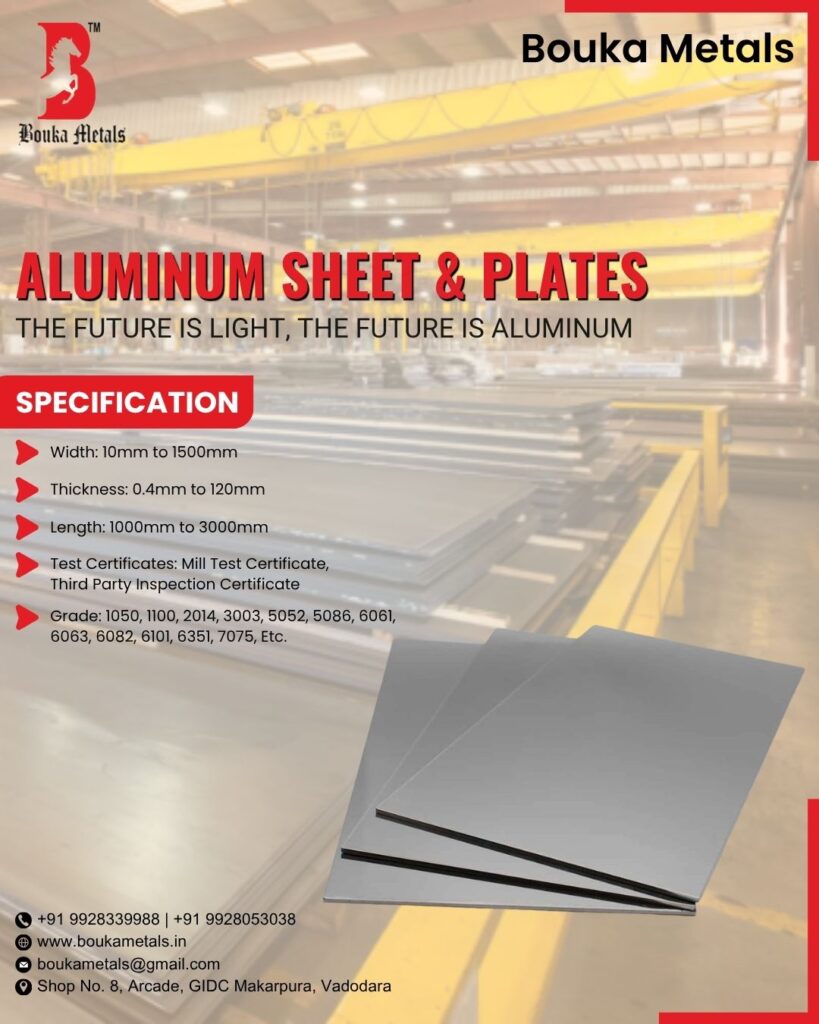
| Specification | Details |
|---|---|
| Width | 10 mm to 1500 mm |
| Thickness | 0.4 mm to 120 mm |
| Length | 1000 mm to 3000 mm |
| Test Certificates | Mill Test Certificate, Third-Party Inspection Certificate |
| Grades Available | 1050, 1100, 2014, 3003, 5052, 5086, 6061, 6063, 6082, 6101, 6351, 7075 |
Available Aluminum Grades
1050 Grade
Known for excellent corrosion resistance and high ductility, making it suitable for chemical processing and decorative applications.
1100 Grade
Provides superior workability and thermal conductivity for industrial and commercial applications.
2014 Grade
A high-strength alloy commonly used in engineering and aerospace-related applications.
3003 Grade
Offers a balance of strength and corrosion resistance, making it ideal for fabrication and roofing projects.
5052 Grade
Widely used in marine and transportation industries due to excellent resistance to harsh environments.
5086 Grade
Suitable for shipbuilding and heavy-duty marine structures where durability is essential.
6061 Grade
One of the most versatile alloys, offering excellent strength, machinability, and weldability.
6063 Grade
Commonly used in architectural and extrusion applications because of its attractive finish.
6082 Grade
Provides higher mechanical strength and is preferred for structural engineering applications.
6101 Grade
Primarily utilized in electrical systems where conductivity is required.
6351 Grade
Offers good structural performance and is often used in transportation and engineering sectors.
7075 Grade
A high-strength alloy widely used in aerospace, defense, and precision engineering industries.
Key Advantages
Lightweight Construction
Aluminum significantly reduces overall structural weight without compromising performance.
Corrosion Resistance
The natural oxide layer helps protect the material against rust and environmental damage.
High Strength
Modern aluminum alloys deliver impressive mechanical properties suitable for demanding applications.
Excellent Fabrication Properties
The material can be easily cut, welded, bent, machined, and formed into various shapes.
Long Service Life
Its durability ensures reliable performance over extended periods with minimal maintenance.
Sustainable Material Choice
Aluminum is fully recyclable and supports environmentally responsible manufacturing practices.
Industrial Applications
Construction Industry
Used in roofing systems, cladding, facades, structural supports, and architectural projects.
Automotive Industry
Helps reduce vehicle weight while improving efficiency and performance.
Aerospace Industry
Used in aircraft components and structures requiring high strength and reduced weight.
Marine Industry
Suitable for shipbuilding, offshore structures, and equipment exposed to corrosive environments.
Electrical Industry
Widely used in conductors, busbars, electrical enclosures, and power distribution systems.
Manufacturing Industry
Applied in machinery fabrication, industrial equipment, storage systems, and production facilities.
Factors to Consider Before Purchasing
Material Grade
Select the appropriate alloy grade based on the intended application and performance requirements.
Thickness Requirement
Determine the correct thickness according to load-bearing and fabrication needs.
Certification Standards
Ensure the material is supplied with quality inspection and testing certificates.
Surface Finish
Choose a finish suitable for both functional and aesthetic requirements.
Supplier Reliability
Working with a trusted supplier helps ensure consistent quality, availability, and technical support.
Why Choose Quality Aluminum Products?
Premium-quality aluminum materials offer enhanced durability, consistent mechanical properties, and reliable performance across industrial applications. Certified products help maintain quality standards while reducing operational risks and maintenance costs. Choosing high-grade materials ultimately contributes to better efficiency and long-term project success.
Frequently Asked Questions
What is the difference between aluminum sheets and aluminum plates?
The primary difference is thickness. Sheets are thinner and suitable for light fabrication, while plates are thicker and designed for structural applications.
Which aluminum grades are suitable for marine environments?
Grades 5052 and 5086 are commonly used in marine applications due to their excellent corrosion resistance.
Can aluminum be welded?
Yes, many aluminum alloys offer excellent weldability and are commonly used in fabrication projects.
Is aluminum resistant to corrosion?
Yes, aluminum naturally forms a protective oxide layer that helps resist corrosion.
Are aluminum products recyclable?
Yes, aluminum is 100% recyclable and can be reused without losing its original properties.
What certificates are available with aluminum materials?
Mill Test Certificates and Third-Party Inspection Certificates are commonly provided for quality assurance.
Which industries use aluminum plates?
Construction, aerospace, automotive, marine, electrical, and manufacturing industries extensively use aluminum plates.
Conclusion
Aluminum Sheet & Plates continue to be among the most versatile materials used in modern industries. Their combination of lightweight properties, strength, corrosion resistance, and fabrication flexibility makes them suitable for a wide range of applications. Available in multiple grades and dimensions, they provide dependable solutions for construction, transportation, marine, aerospace, and manufacturing projects.
Selecting the right grade, dimensions, and certified supplier ensures long-term performance, operational efficiency, and value for industrial applications.
Check this :- https://www.bis.gov.in/
