

Table of Contents
- Introduction to Copper Strips
- What Are Copper Strips?
- Key Features
- Technical Specifications
- Types of Copper Strips
- Manufacturing Process
- Advantages of Copper Strips
- Industrial Applications
- Quality Standards and Testing
- Factors to Consider Before Purchasing
- Why Choose Bouka Metals?
- Frequently Asked Questions
- Conclusion
Introduction to Copper Strips
In today’s rapidly developing industrial landscape, efficient electrical transmission and reliable energy distribution have become essential requirements across virtually every sector. From manufacturing facilities and power plants to renewable energy projects and transportation systems, the demand for highly conductive materials continues to grow. Among the various materials available for electrical and engineering applications, copper remains one of the most trusted and widely used metals due to its outstanding conductivity, durability, and versatility.
Copper strips are precision-engineered flat metal products manufactured to deliver consistent performance in demanding environments. Their ability to carry electrical current efficiently while maintaining structural integrity makes them an important component in numerous industrial systems. These products are extensively used in switchgear assemblies, transformers, control panels, grounding systems, electrical distribution networks, battery systems, renewable energy installations, and heavy engineering equipment.
One of the primary reasons for their widespread adoption is their excellent balance between performance and longevity. Unlike many alternative materials, copper offers superior conductivity while resisting corrosion and environmental degradation. This ensures dependable operation even under challenging conditions where reliability is critical.
The increasing focus on energy efficiency and sustainable infrastructure has further strengthened the importance of high-quality conductive materials. Modern electrical systems require components that minimize power losses, improve operational efficiency, and support long-term performance. Properly manufactured copper strips help meet these objectives by providing excellent current-carrying capability and thermal stability.
Bouk Metals In addition to electrical applications, these products are valued for their ease of fabrication. They can be cut, bent, punched, welded, and customized according to specific project requirements. This flexibility allows engineers and manufacturers to incorporate them into a wide variety of designs without compromising functionality or efficiency.
As industries continue to expand and technological advancements drive greater energy demands, the role of precision-manufactured copper products becomes increasingly important. Whether used in power distribution systems, industrial machinery, renewable energy infrastructure, or advanced engineering projects, copper strips contribute significantly to reliability, efficiency, and operational excellence.
What Are Copper Strips?
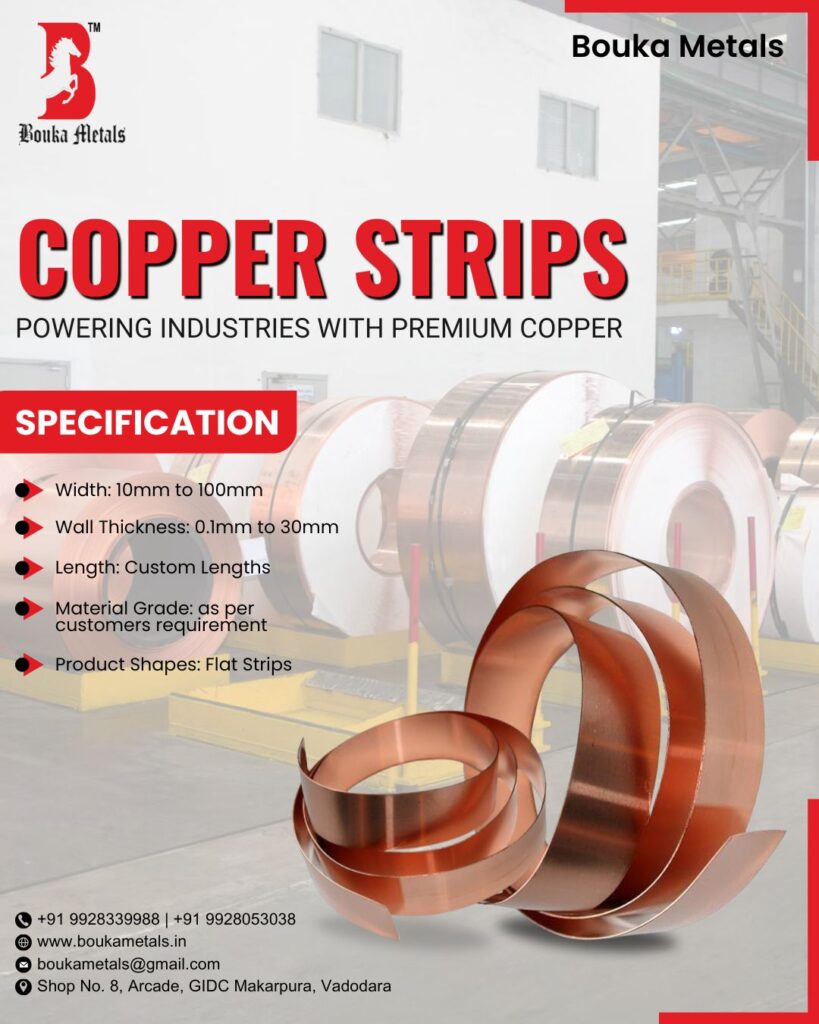
Copper strips are flat-rolled metal products manufactured from high-purity copper through advanced rolling and processing techniques. They are produced in various widths, thicknesses, tempers, and finishes to suit different industrial and commercial applications.
These products are specifically designed to provide excellent electrical and thermal performance while maintaining flexibility and mechanical strength. Their adaptability makes them suitable for both standard and custom-engineered solutions.
Key Features
Excellent Electrical Conductivity
Copper is recognized worldwide for its exceptional ability to conduct electrical current efficiently.
High Thermal Conductivity
The material transfers heat effectively, making it suitable for temperature-sensitive applications.
Corrosion Resistance
Natural resistance to environmental exposure helps extend product life and reduce maintenance.
Precision Manufacturing
Produced with accurate dimensions and consistent quality for reliable performance.
Easy Fabrication
Can be processed using various fabrication methods including cutting, bending, punching, and welding.
Long Service Life
Offers dependable performance over extended operational periods.
Technical Specifications
| Specification | Details |
|---|---|
| Material | High Purity Copper |
| Width | 10 mm to 100 mm |
| Thickness | 0.1 mm to 30 mm |
| Length | Custom Length Available |
| Shape | Flat Strip |
| Grade | As Per Customer Requirement |
| Surface Finish | Bright Finish / Mill Finish |
| Conductivity | High |
| Custom Manufacturing | Available |
Types of Copper Strips
Bare Copper Strips
Widely used in electrical grounding systems and power distribution applications.
Annealed Copper Strips
Provide improved flexibility and are suitable for forming and bending operations.
Rolled Copper Strips
Manufactured for applications requiring dimensional accuracy and uniform thickness.
High Conductivity Strips
Designed for equipment where maximum electrical efficiency is required.
Customized Copper Strips
Produced according to specific drawings, dimensions, and project requirements.
Manufacturing Process
Raw Material Selection
Premium-grade copper is selected to ensure superior conductivity and product consistency.
Melting and Refining
The raw material is processed to achieve desired purity levels and metallurgical properties.
Rolling Operations
Advanced rolling mills produce the required width and thickness dimensions.
Annealing Process
Controlled heat treatment improves ductility and workability.
Surface Finishing
Additional finishing processes enhance appearance and performance characteristics.
Final Inspection
Comprehensive quality checks are performed before products are approved for dispatch.
Advantages of Copper Strips
Improved Energy Efficiency
Excellent conductivity helps reduce energy losses during transmission.
Reliable Performance
Consistent electrical and mechanical properties ensure dependable operation.
Durability
Designed to withstand demanding industrial environments.
Reduced Maintenance
Corrosion resistance contributes to lower maintenance requirements.
Design Flexibility
Available in multiple dimensions and custom configurations.
Sustainable Material Choice
Copper is highly recyclable and supports environmentally responsible manufacturing practices.
Industrial Applications
Electrical Distribution Systems
Used in switchgear panels, substations, and electrical infrastructure projects.
Transformers
Commonly utilized in transformer assemblies and power management equipment.
Renewable Energy Systems
Suitable for solar energy installations and other sustainable power projects.
Grounding and Earthing Networks
Provide reliable electrical safety in commercial and industrial facilities.
Automotive Industry
Used in battery systems, electrical assemblies, and conductive components.
Manufacturing Equipment
Applied in industrial machinery, automation systems, and control panels.
Electronics Industry
Supports efficient electrical performance in various electronic devices and assemblies.
Quality Standards and Testing
Quality plays a vital role in ensuring consistent performance and long-term reliability.
Testing procedures generally include:
- Conductivity Testing
- Chemical Composition Analysis
- Thickness Measurement
- Surface Quality Inspection
- Hardness Testing
- Mechanical Property Evaluation
- Dimensional Verification
These inspections help ensure compliance with industry requirements and customer specifications.
Factors to Consider Before Purchasing
Material Grade
Select the appropriate grade based on conductivity and application requirements.
Dimensional Requirements
Determine suitable width and thickness according to system design.
Operating Conditions
Consider environmental exposure, temperature, and electrical load requirements.
Manufacturing Quality
Choose products manufactured under strict quality control procedures.
Supplier Experience
Work with established manufacturers capable of providing technical support and customization.
Why Choose Bouka Metals?
Bouka Metals provides high-quality copper strips designed to meet the needs of modern industries. With a commitment to precision manufacturing and customer satisfaction, the company delivers reliable solutions for electrical and engineering applications.
Benefits of Choosing Bouka Metals
- Premium-quality raw materials
- Custom dimensions and specifications
- Advanced manufacturing facilities
- Strict quality control procedures
- Competitive pricing
- Timely delivery schedules
- Technical assistance and support
- Industry-focused solutions
Frequently Asked Questions
What are copper strips used for?
They are commonly used in electrical systems, transformers, grounding networks, renewable energy projects, and industrial equipment.
Why is copper preferred for conductive applications?
Copper offers exceptional conductivity, durability, and long-term reliability.
Are custom sizes available?
Yes, products can be manufactured according to project-specific dimensions and specifications.
Can these products be used outdoors?
Yes, they are suitable for many outdoor and industrial environments when properly installed.
Which industries commonly use copper strips?
Electrical, automotive, renewable energy, construction, engineering, manufacturing, and electronics industries.
How are copper strips tested?
Manufacturers perform conductivity, dimensional, mechanical, and chemical testing to ensure quality.
What thickness range is available?
Thickness can range from 0.1 mm to 30 mm depending on application requirements.
Conclusion
Copper strips continue to be an essential component in modern industrial and electrical systems. Their exceptional conductivity, thermal efficiency, durability, and adaptability make them suitable for a broad range of applications across multiple industries.
As infrastructure projects, renewable energy systems, and advanced manufacturing technologies continue to expand, the demand for reliable conductive materials is expected to grow further. Choosing precision-manufactured products from a trusted supplier helps ensure operational efficiency, long service life, and dependable performance.
Bouka Metals delivers high-quality copper strip solutions tailored to meet diverse industrial requirements while maintaining strict quality standards and customer-focused service.
Check this :- https://mines.gov.in/
