

Table of Contents
- Introduction
- What Are Buttweld Fittings?
- Key Features
- Available Types
- Technical Specifications
- Industrial Applications
- Advantages
- Quality Assurance
- Comparison Table
- Frequently Asked Questions
- Conclusion
Introduction
Bouk Metals Modern industries depend on efficient piping systems for the safe transportation of liquids, gases, steam, and chemicals. To ensure smooth flow management and reliable connections, high-quality buttweld fittings play a crucial role in industrial pipelines. These components are designed to create permanent welded joints that offer excellent strength, leak resistance, and long-term performance.
Widely used in sectors such as oil and gas, petrochemicals, power generation, food processing, pharmaceuticals, water treatment, and heavy engineering, these piping components are known for their durability and ability to withstand demanding operating conditions. Their seamless integration with pipelines helps reduce pressure losses while improving overall system efficiency.
Manufactured using advanced production techniques and strict quality controls, buttweld fittings are available in various configurations to meet diverse piping requirements. Whether a project requires directional changes, branch connections, size reductions, or pipe-end closures, these fittings provide dependable solutions for complex industrial systems.
The growing demand for reliable piping infrastructure has increased the importance of precision-engineered fittings that comply with international standards. By selecting products from a trusted manufacturer, industries can achieve enhanced operational safety, lower maintenance costs, and improved system reliability. This guide covers the major types, applications, technical specifications, advantages, and frequently asked questions to help buyers and engineers make informed decisions.
Key Features
- Strong welded connections
- Excellent pressure-handling capability
- Leak-resistant performance
- Suitable for high-temperature environments
- Corrosion-resistant material options
- Smooth internal surface for better flow
- Long service life
- Low maintenance requirements
- Available in multiple dimensions
- Compatible with industrial piping standards
What Are Buttweld Fittings?
These are piping components that are joined to pipes through welding. The welding process creates a strong and permanent connection, making them suitable for applications where durability and reliability are essential.
They are commonly used to:
- Change flow direction
- Create branch connections
- Reduce pipe diameter
- Terminate pipeline ends
- Connect piping sections efficiently
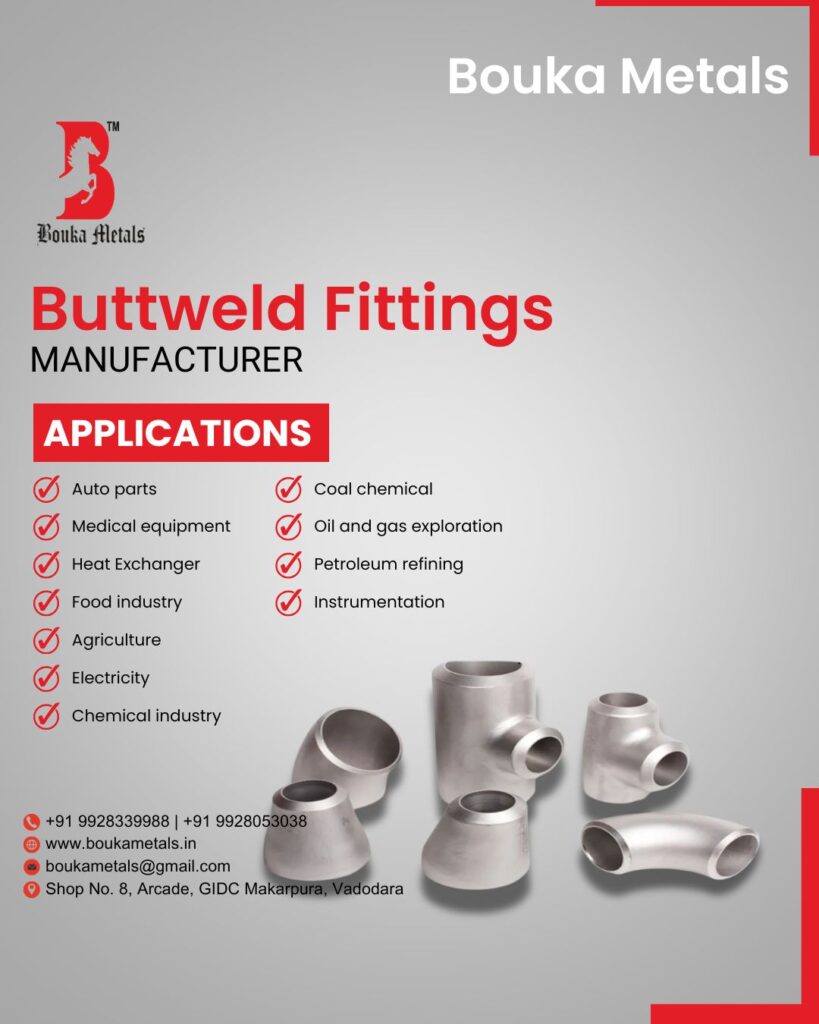
Available Types
Pipe Elbows
Used to change the direction of flow within a piping system.
Pipe Tees
Designed to create branch connections from the main pipeline.
Pipe Reducers
Used when connecting pipes of different diameters.
Pipe Caps
Installed to close the end of a pipeline securely.
Stub Ends
Commonly used with lap joint flanges for easy maintenance and dismantling.
Cross Fittings
Provide four-way flow distribution where required.
Technical Specifications
| Specification | Details |
|---|---|
| Product Type | Welded Piping Components |
| Manufacturing Method | Hot Formed / Fabricated |
| Connection Type | Butt Weld |
| Surface Finish | Machined & Finished |
| Pressure Service | Industrial Applications |
| Inspection | Dimensional & Visual Testing |
| Testing | Third-Party Inspection Available |
| Packaging | Export Worthy Packaging |
| Standards | As Per Industry Requirements |
Industrial Applications
Oil and Gas Exploration
Used in transportation systems handling crude oil, natural gas, and refined products.
Petroleum Refining
Installed in refinery piping networks for efficient process operations.
Chemical Industry
Suitable for handling aggressive chemicals and process fluids.
Heat Exchanger Systems
Used in thermal transfer equipment requiring dependable flow connections.
Food Processing Industry
Applied in hygienic processing systems and production lines.
Medical Equipment Manufacturing
Utilized in specialized fluid handling and manufacturing equipment.
Agriculture Sector
Used in irrigation systems and agricultural processing plants.
Instrumentation Systems
Supports precision fluid control applications.
Power and Electricity Industry
Installed in thermal, hydro, and industrial power generation facilities.
Coal Chemical Industry
Used for process pipelines operating under demanding conditions.
Advantages
| Feature | Benefit |
|---|---|
| Welded Construction | Strong and permanent joints |
| Smooth Flow Path | Reduced turbulence |
| High Strength | Reliable operation |
| Leak Resistance | Improved safety |
| Durability | Long operational life |
| Easy Integration | Compatible with industrial systems |
| Low Maintenance | Reduced operating costs |
Quality Assurance
Reliable manufacturers maintain strict quality procedures, including:
- Raw material verification
- Dimensional inspection
- Visual examination
- Welding quality checks
- Mechanical testing
- Third-party inspection support
- Secure export packaging
These measures ensure product consistency, safety, and compliance with industrial requirements.
Comparison Table
| Feature | Welded Fittings | Threaded Connections |
|---|---|---|
| Joint Strength | High | Moderate |
| Leak Resistance | Excellent | Good |
| Durability | Superior | Standard |
| Maintenance | Low | Moderate |
| High Pressure Service | Suitable | Limited |
| Long-Term Reliability | Excellent | Good |
Frequently Asked Questions
What are buttweld fittings used for?
They are used to connect, redirect, reduce, or terminate pipelines in industrial systems.
Which industries commonly use these fittings?
Oil and gas, chemical processing, power generation, food manufacturing, pharmaceuticals, and water treatment industries.
Why are welded connections preferred?
Welded joints provide stronger and more reliable connections with lower leakage risk.
Are these fittings suitable for high-pressure applications?
Yes, they are widely used in high-pressure and high-temperature environments.
What types are commonly available?
Elbows, tees, reducers, caps, stub ends, and crosses are among the most commonly used varieties.
Can they be customized?
Yes, dimensions and specifications can be manufactured according to project requirements.
Is inspection available?
Yes, third-party inspection and testing services are generally available upon request.
What are the benefits of welded joints?
They provide strength, durability, leak resistance, and long-term operational reliability.
Conclusion
Buttweld fittings are essential components in modern piping systems, providing strong, durable, and leak-resistant connections for a wide range of industrial applications. Their ability to perform under high pressure, extreme temperatures, and demanding operating environments makes them a preferred choice across numerous sectors.
By choosing products from a trusted manufacturer with strict quality standards and inspection procedures, industries can achieve improved safety, efficient operations, and long-term cost savings. Whether used in energy, chemical processing, food production, or infrastructure projects, these fittings continue to play a vital role in maintaining reliable piping networks.
check this :- https://www.commerce.gov.in/
