

Table of Contents
- Introduction
- What Are Carbon Steel Flanges?
- Key Features
- Types of Carbon Steel Flanges
- Technical Specifications
- Industrial Applications
- Benefits of Using Carbon Steel Flanges
- Quality Standards and Inspection
- Comparison Table
- Frequently Asked Questions
- Conclusion
Introduction
The modern industrial sector relies heavily on strong and reliable piping systems to transport liquids, gases, steam, and various process materials safely and efficiently. One of the most important components in these systems is the carbon steel flange. Designed to connect pipes, valves, pumps, and other equipment, flanges provide secure joints that simplify installation, maintenance, and system expansion.
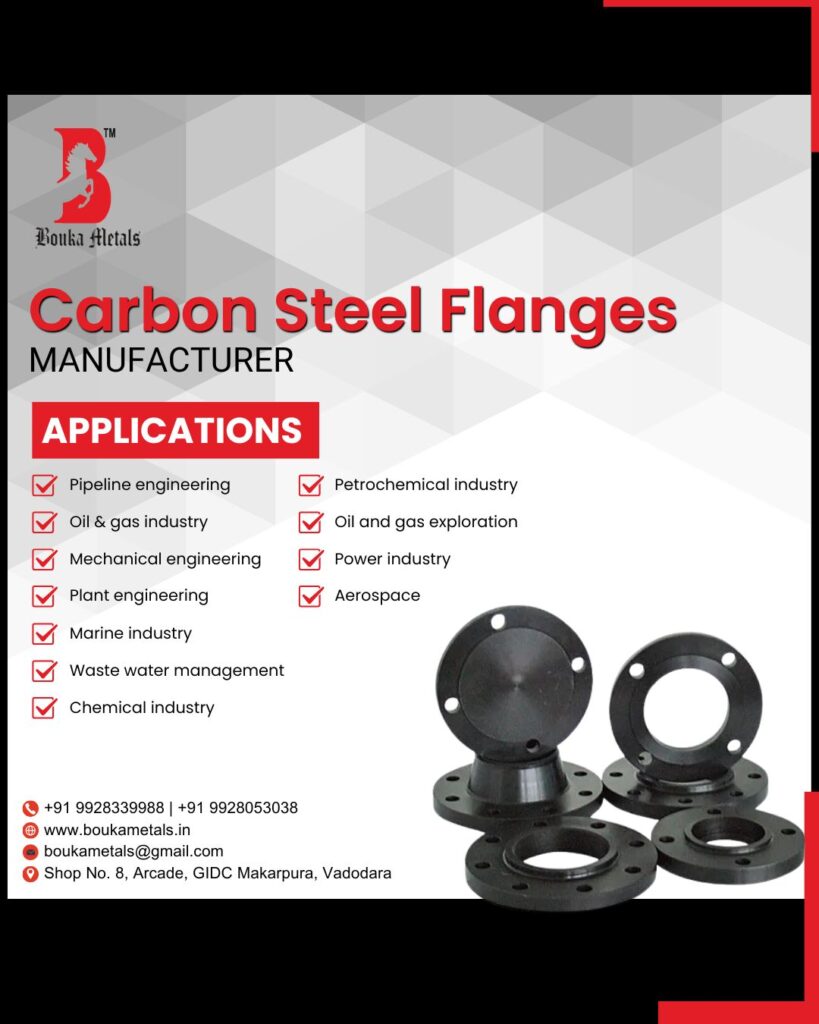
Bouk Metals Due to their excellent mechanical strength, durability, and cost-effectiveness, carbon steel flanges are widely used in industries such as oil and gas, petrochemicals, power generation, marine engineering, wastewater treatment, pipeline construction, and process manufacturing. These components are engineered to withstand demanding operating conditions, including high pressure, elevated temperatures, and continuous industrial usage.
Available in multiple configurations and dimensions, flanges help create leak-resistant connections while allowing easy inspection and maintenance of piping systems. Their versatility makes them suitable for both small-scale installations and large industrial projects where operational reliability is critical.
Manufactured according to recognized industry standards, these products undergo rigorous quality checks to ensure dimensional accuracy, structural integrity, and long-term performance. Whether used in refineries, chemical processing facilities, power plants, or engineering projects, carbon steel flanges continue to play a vital role in maintaining safe and efficient industrial operations.
This guide explores their types, specifications, applications, advantages, and frequently asked questions to help engineers, procurement teams, and project managers make informed purchasing decisions.
Key Features
- High mechanical strength
- Excellent pressure resistance
- Durable construction
- Cost-effective solution
- Easy installation and maintenance
- Suitable for high-temperature applications
- Available in various pressure classes
- Precision-machined dimensions
- Long service life
- Reliable sealing performance
What Are Carbon Steel Flanges?
Carbon steel flanges are pipe connection components used to join piping sections, valves, pumps, and process equipment. They are typically bolted together with a gasket placed between mating surfaces to create a secure and leak-resistant seal.
These components provide flexibility for maintenance, inspection, cleaning, and future modifications within industrial piping systems.
Types of Carbon Steel Flanges
Weld Neck Flanges
Designed for high-pressure applications, these flanges provide excellent strength and stress distribution.
Slip-On Flanges
Installed by sliding over the pipe before welding, making them suitable for low to moderate pressure systems.
Blind Flanges
Used to seal the end of a piping system and allow future expansion or inspection.
Socket Weld Flanges
Commonly used in smaller-diameter piping systems where strong connections are required.
Threaded Flanges
Feature internal threads that eliminate the need for welding during installation.
Lap Joint Flanges
Used with stub ends and preferred in systems requiring frequent dismantling.
Orifice Flanges
Designed for flow measurement and monitoring applications.
Technical Specifications
| Specification | Details |
|---|---|
| Product Type | Industrial Pipe Flanges |
| Material | Carbon Steel |
| Manufacturing Method | Forged / Machined |
| Pressure Ratings | Various Industrial Classes |
| Connection Type | Welded / Threaded |
| Surface Finish | Machined Finish |
| Inspection | Visual & Dimensional Testing |
| Testing | Third-Party Inspection Available |
| Packaging | Export Quality Packaging |
Industrial Applications
Pipeline Engineering
Used for connecting transmission and distribution pipelines.
Oil & Gas Industry
Suitable for upstream, midstream, and downstream operations.
Petrochemical Plants
Installed in processing units handling chemicals and hydrocarbons.
Mechanical Engineering
Used in machinery and process equipment piping systems.
Plant Engineering
Supports industrial infrastructure and utility networks.
Marine Industry
Suitable for shipbuilding and offshore applications.
Wastewater Management
Used in treatment facilities and water transportation systems.
Chemical Processing
Provides secure connections in chemical handling systems.
Power Industry
Installed in thermal, hydro, and industrial power plants.
Aerospace Sector
Used in specialized engineering and support systems.
Benefits of Using Carbon Steel Flanges
| Feature | Benefit |
|---|---|
| Strong Construction | Reliable performance |
| Easy Maintenance | Simplified inspection |
| Leak Resistance | Improved operational safety |
| Cost Efficiency | Economical for industrial use |
| Versatility | Suitable for multiple sectors |
| Long Service Life | Reduced replacement costs |
| Easy Assembly | Faster installation |
Quality Standards and Inspection
To ensure consistent quality and performance, manufacturers typically perform:
- Raw material verification
- Dimensional inspection
- Surface finish inspection
- Mechanical testing
- Visual examination
- Pressure testing
- Third-party inspection support
- Packaging verification
These quality procedures help ensure compliance with industrial standards and project requirements.
Comparison Table
| Feature | Carbon Steel Flanges | Stainless Steel Flanges |
|---|---|---|
| Strength | High | High |
| Cost | Economical | Higher |
| Durability | Excellent | Excellent |
| Corrosion Resistance | Good | Superior |
| Industrial Usage | Extensive | Specialized |
| Maintenance | Moderate | Low |
Frequently Asked Questions
What are carbon steel flanges used for?
They are used to connect pipes, valves, pumps, and industrial equipment within piping systems.
Which industries commonly use these products?
Oil and gas, petrochemical, marine, power generation, wastewater treatment, and engineering industries.
Why are flanged connections preferred?
They allow easy maintenance, inspection, and equipment replacement without cutting pipelines.
Are carbon steel flanges suitable for high-pressure systems?
Yes, many flange types are specifically designed for demanding pressure applications.
What types are commonly available?
Weld neck, slip-on, blind, threaded, socket weld, lap joint, and orifice designs are widely used.
Can these products be customized?
Yes, dimensions, pressure ratings, and specifications can be manufactured according to project requirements.
Is third-party inspection available?
Yes, inspection and testing services can be arranged based on customer requirements.
What is the main advantage of carbon steel?
It offers an excellent balance of strength, durability, and cost-effectiveness.
Conclusion
Carbon steel flanges are essential components in modern industrial piping systems, offering dependable connections for a wide range of applications. Their strength, versatility, and economic value make them a preferred choice across sectors such as pipeline engineering, petrochemical processing, power generation, marine operations, and wastewater management.
When sourced from a trusted manufacturer that follows strict quality control procedures, these components deliver reliable performance, enhanced safety, and long-term operational efficiency. Selecting the right flange type and specification helps ensure the success of industrial projects while minimizing maintenance and downtime.
Check this :- https://heavyindustries.gov.in/
