

Table of Contents
- Introduction
- What Are Forged Fittings?
- Key Features of Forged Fittings
- Types of Forged Fittings
- Technical Specifications
- Industrial Applications
- Advantages of Forged Fittings
- Quality Standards and Inspection
- Forged Fittings vs Cast Fittings
- Frequently Asked Questions
- Conclusion
Introduction
Forged fittings are essential piping components used to connect, redirect, control, and terminate fluid flow in piping systems. Manufactured through a forging process, these fittings offer superior strength, durability, and reliability compared to conventional cast fittings.
Due to their excellent pressure-handling capabilities and structural integrity, forged fittings are widely used across industries such as oil and gas, chemical processing, power generation, food manufacturing, instrumentation, and petrochemical plants.
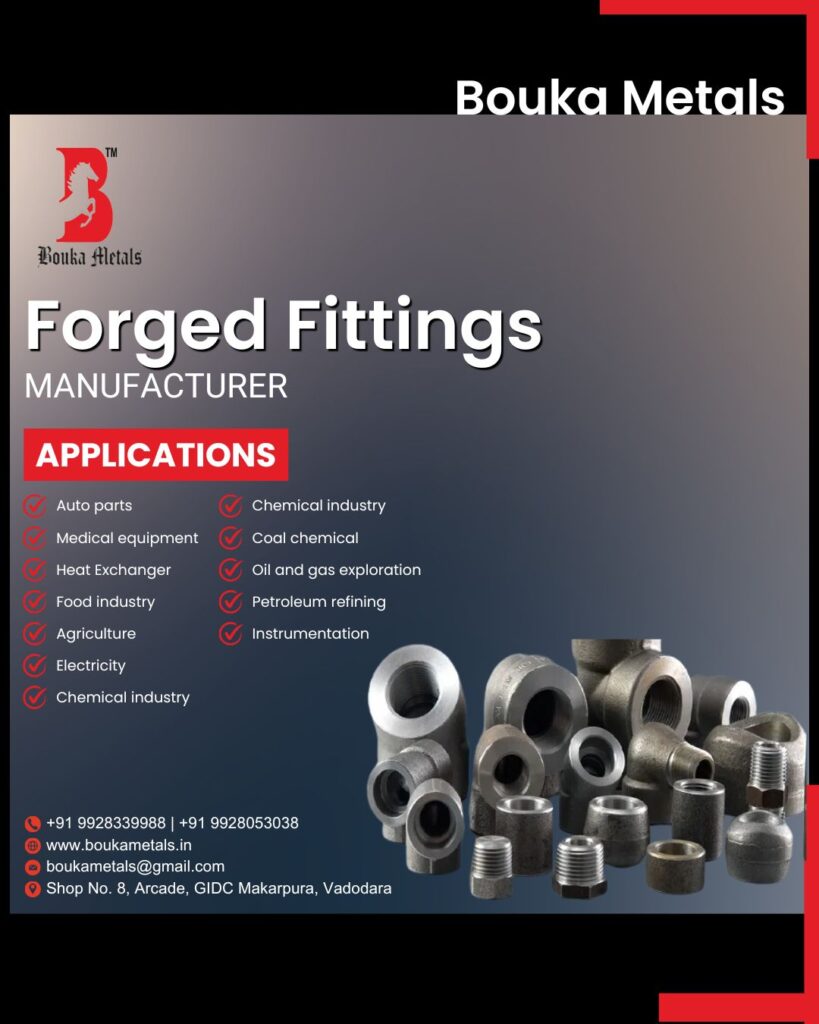
Bouk metals Forged fittings are manufactured through a specialized forging process in which metal is subjected to high pressure and temperature to create components with exceptional mechanical strength and structural integrity. Unlike cast fittings, forged fittings possess a refined grain structure that enhances their durability, pressure resistance, and overall performance in demanding operating conditions.
These fittings are widely used for connecting pipes, changing flow directions, reducing pipe sizes, sealing pipe ends, and creating branch connections in complex piping networks. Their ability to withstand high pressure, extreme temperatures, vibration, and corrosive environments makes them a preferred choice for critical industrial applications where safety and reliability are essential.
What Are Forged Fittings?
Forged fittings are pipe fittings produced by shaping metal under high pressure and temperature. This manufacturing process refines the grain structure of the material, resulting in stronger and more durable components.
These fittings are commonly available in threaded and socket weld configurations and are designed to withstand high pressure, temperature fluctuations, and corrosive environments.
Key Features of Forged Fittings
- High mechanical strength
- Excellent pressure resistance
- Superior durability
- Corrosion-resistant materials available
- Leak-proof connections
- Precision manufacturing
- Suitable for high-temperature applications
- Long operational lifespan
- Available in multiple sizes and pressure ratings
- Easy installation and maintenance
Types of Forged Fittings
Forged Elbows
Used to change the direction of flow within a piping system while maintaining pressure efficiency.
Forged Tees
Designed to create branch connections in pipelines and distribute fluid flow.
Forged Couplings
Used to connect two pipes securely and maintain a leak-free system.
Forged Unions
Allow easy disconnection and maintenance of piping systems without cutting pipes.
Forged Bushings
Used for reducing pipe sizes and connecting different diameters.
Forged Plugs
Installed to close the end of pipes or fittings securely.
Forged Caps
Used for sealing pipeline ends and protecting systems from contamination.
Forged Crosses
Allow four-way fluid distribution within industrial piping networks.
Technical Specifications
| Specification | Details |
|---|---|
| Product Type | Forged Pipe Fittings |
| Connection Type | Threaded / Socket Weld |
| Pressure Ratings | Various Industrial Standards |
| Manufacturing Process | Hot Forging |
| Surface Finish | Machined & Finished |
| Inspection | Visual & Dimensional Testing |
| Material Grades | Available as per Industry Requirements |
| Testing | Third-Party Inspection Available |
| Packaging | Export Worthy Packaging |
Industrial Applications
Oil and Gas Exploration
Forged fittings are extensively used in upstream, midstream, and downstream operations where pressure resistance is critical.
Petroleum Refining
Refineries depend on forged fittings for safe transportation of hydrocarbons and process fluids.
Chemical Industry
Chemical plants utilize forged fittings because of their strength and compatibility with corrosive substances.
Coal Chemical Industry
Used in pipelines handling chemical by-products and industrial process fluids.
Instrumentation Systems
Precision piping systems rely on forged fittings for accurate fluid control and leak-free performance.
Heat Exchanger Systems
Used in thermal transfer systems requiring durable and pressure-resistant components.
Medical Equipment Manufacturing
Applied in specialized fluid handling and process equipment.
Food Processing Industry
Suitable for hygienic piping applications where reliability and cleanliness are essential.
Agriculture Sector
Used in irrigation systems, fertilizer processing, and agricultural equipment.
Power and Electricity Industry
Installed in power plants and energy production facilities for fluid and gas transportation.
Advantages of Forged Fittings
| Benefit | Description |
|---|---|
| High Strength | Stronger than cast fittings |
| Reliable Performance | Consistent operation under pressure |
| Leak Resistance | Secure and dependable connections |
| Long Service Life | Reduced replacement costs |
| Corrosion Resistance | Suitable for harsh environments |
| Dimensional Accuracy | Precise fitting and installation |
| Safety | Improved system reliability |
Quality Standards and Inspection
Quality assurance is essential in forged fitting manufacturing. Reputed manufacturers perform:
- Raw material verification
- Dimensional inspection
- Visual examination
- Pressure testing
- Mechanical property testing
- Third-party inspection
- Packaging quality checks
Mill Test Certificates (MTC) and inspection reports are often provided to ensure compliance with industry standards.
Forged Fittings vs Cast Fittings
| Feature | Forged Fittings | Cast Fittings |
|---|---|---|
| Strength | Higher | Moderate |
| Pressure Handling | Excellent | Good |
| Durability | Superior | Standard |
| Grain Structure | Refined | Less Dense |
| Reliability | High | Moderate |
| Service Life | Longer | Shorter |
| Safety | Better | Standard |
Frequently Asked Questions (FAQs)
What are forged fittings used for?
Forged fittings are used to connect, control, redirect, and terminate flow in industrial piping systems.
Which industries commonly use forged fittings?
Oil and gas, chemical processing, food manufacturing, power generation, instrumentation, agriculture, and petrochemical industries.
Why are forged fittings stronger than cast fittings?
The forging process refines the metal grain structure, resulting in improved strength and durability.
What connection types are available?
Forged fittings are generally available in threaded and socket weld configurations.
Are forged fittings suitable for high-pressure applications?
Yes, forged fittings are specifically designed for demanding high-pressure and high-temperature environments.
Can forged fittings be used in chemical plants?
Yes, they are widely used in chemical processing facilities due to their strength and reliability.
Is third-party inspection available?
Yes, third-party testing and inspection services can be provided based on project requirements.
Do forged fittings require frequent maintenance?
No, high-quality forged fittings offer long service life with minimal maintenance requirements.
Conclusion
Forged fittings play a critical role in modern industrial piping systems by providing strong, durable, and leak-resistant connections. Their ability to withstand extreme pressure, temperature variations, and demanding operating conditions makes them an ideal choice for industries such as oil & gas, petrochemicals, power generation, food processing, and instrumentation.
By choosing premium-quality forged fittings manufactured to industry standards, businesses can improve operational efficiency, safety, and long-term reliability while reducing maintenance costs.
Check this :- https://mopng.gov.in/
